THE DUBAI DIVIDE
9/7/20254 min read
The Dubai Divide
A City Built by Tenants, Owned by Investors. Can a First-Time Buyer Program Fix It?
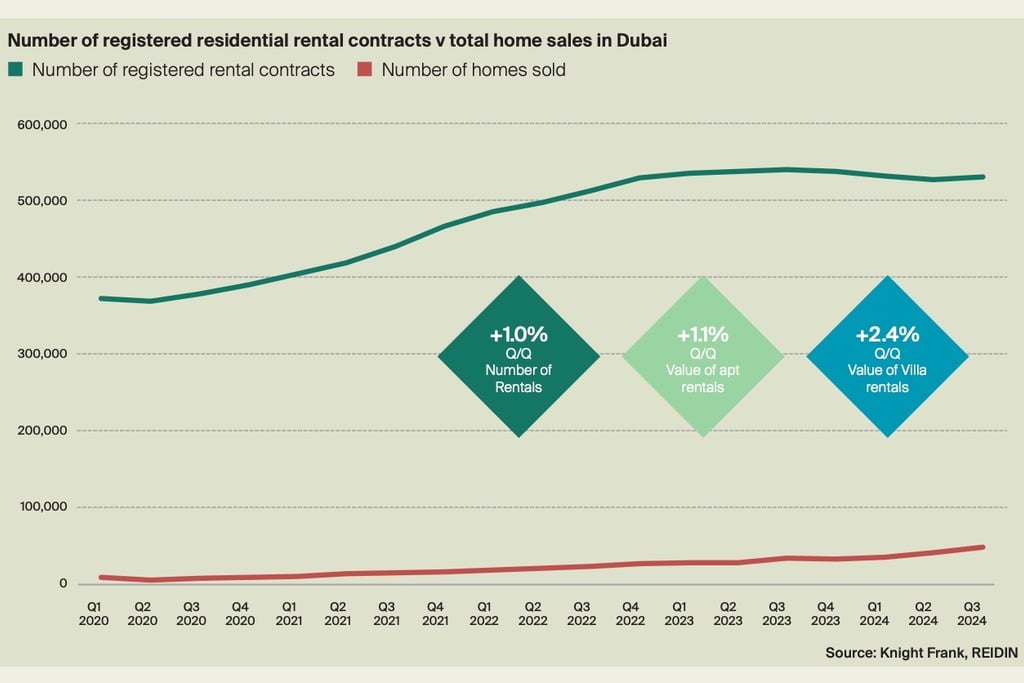
Dubai is a city of tenants, this chart goes beyond mere data; it encapsulates the very essence of modern Dubai. It unveils a profound truth: the emirate is not a city of homeowners, but a global powerhouse built on a foundation of tenants. In 2024, over half a million individuals signed rental contracts as compared to fraction of home sales. While Dubai shines as a magnet for international investment, a generation of young engineers, entrepreneurs, and professionals find themselves on the sidelines of the prosperity they are building. They are financially marginalized, their high rental payments funneled into an investor's yield instead of building their own equity, trapping them in a cycle that prevents them from ever saving enough to escape it.
But why has this happened? What are the systemic issues in the property market that perpetuate this cycle, and how can initiatives like the First-Time Home Buyer Program (FTHBP) not just offer a solution but fundamentally rebalance the entire ecosystem? The answers lie in understanding the anatomy of the ownership barrier.
The Anatomy of an Ownership Barrier
The root cause of this imbalance lies not in a lack of desire. Ask any long-term resident renting an apartment; the aspiration to own a piece of the city they call home is palpable. However, the barrier is structural and straightforward: liquidity.
While a monthly mortgage payment might be comparable to, or even lower than, the current exorbitant rent, the requirement for a 26% minimum down payment in cash presents an insurmountable obstacle for most. They are trapped in a cycle of paying high rents that paradoxically hinder their ability to save enough to break free from those same rents.
This has resulted in a perverse economic transfer. As per Property Finder, families earning between AED 8,000 and 25,000 allocate an astonishing 52% of their income to housing—a figure far surpassing the global 30% affordability benchmark. This capital, which could be building equity for a family, is instead diverted into the yield of an investment property.
The Investor-Tenant Divide: A Market at War With Itself
This system engenders two distinct classes with diametrically opposed interests, leading to a volatile and cyclical market.
The Tenant Class: Their primary economic interest lies in a weak property market. Stable or falling prices lead to lower rents, negatively impacting their financial well-being. Their financial stability is inversely correlated with the sensational success of the real estate sector.
The Investor Class: The majority of the affordable housing inventory (80% of the market) is owned by non-resident investors. Their motivation is solely financial gain, making them highly susceptible to market sentiment. Their strategy often follows a herd mentality, buying on FOMO (Fear Of Missing Out) and selling on the first sign of weakness. This sentiment-driven capital is the driving force behind Dubai’s infamous boom-bust cycles.
The crucial missing component is the Owner-Occupier—the resident whose decision to buy or sell is based on their life needs, not quarterly gains. This group serves as the essential stabilizer that maintains market stability in other parts of the world. Without them, Dubai’s property sector is akin to a ship without a keel, tossed by every wave of investor sentiment.
The Masterstroke: A Program to Foster Stakeholders
Recognizing this existential flaw, the Dubai Land Department (#DLD) and the Department of Economy and Tourism (#DET) have taken decisive, strategic actions. The #FirstTimeHomeBuyerProgram (#FTHBP) is not merely a policy adjustment; it is a direct and intelligent intervention aimed at reshaping the market’s fundamental structure.
By collaborating with banks and developers to overcome the liquidity barrier through low down payments, special rates, and priority access, the government is not only assisting individuals in purchasing apartments but also systematically creating a new class of citizens—the stakeholders.
The cascading benefits of an ownership society are evident in the success of the #FTHBP. Its impact will be measured not only by transaction volumes but also by its profound second-order effects:
1. The Great Stabilization: Replacing transient investor inventory with long-term owner-occupiers injects stability into the housing market. Homeowners are less likely to sell in a panic, leading to reduced volatility and a more resilient and sustainable market.
2. The Talent Anchor: By aligning housing policy with the Golden Visa scheme, the program transforms it into a superior economic and talent retention policy. It incentivizes the world’s best and brightest to not only rent a life in Dubai but also invest their future here, building families, businesses, and lasting legacy wealth within the emirate.
3. The Yield Correction: This is the master stroke. As a critical mass of tenants become owners, rental demand softens. The artificial pressure that has created the world’s highest rental yields—often 7-8%, double that of London or New York—will begin to ease. This will make the city more affordable and, crucially, realign property valuations with global norms. Currently, the “Income Capitalization Approach” used by investors—valuing an asset based on its rental income—actively suppresses the true value of Dubai’s residential stock due to these inflated yield expectations. Normalizing yields will unlock billions in latent equity, benefiting the entire market.
In conclusion,
"The goal is to build a city for people, not just capital".
The graph at the top of this page narrates the tale of the old Dubai—a spectacular, efficient, yet ultimately fleeting rental empire. The #FTHBP marks the inaugural, masterful chapter in a new narrative. It’s a visionary wager that the future of Dubai lies not merely in being the world’s most dynamic hub for work, but in becoming its most captivating destination for settling down, building a life, and truly owning a piece of tomorrow.
( Your guide to the Dubai First-Time Home Buyer Program),